Comparing GFRP Rebar with Stainless Steel and Carbon Steel Rebar
- Kamal Sharma
- Oct 30, 2025
- 4 min read

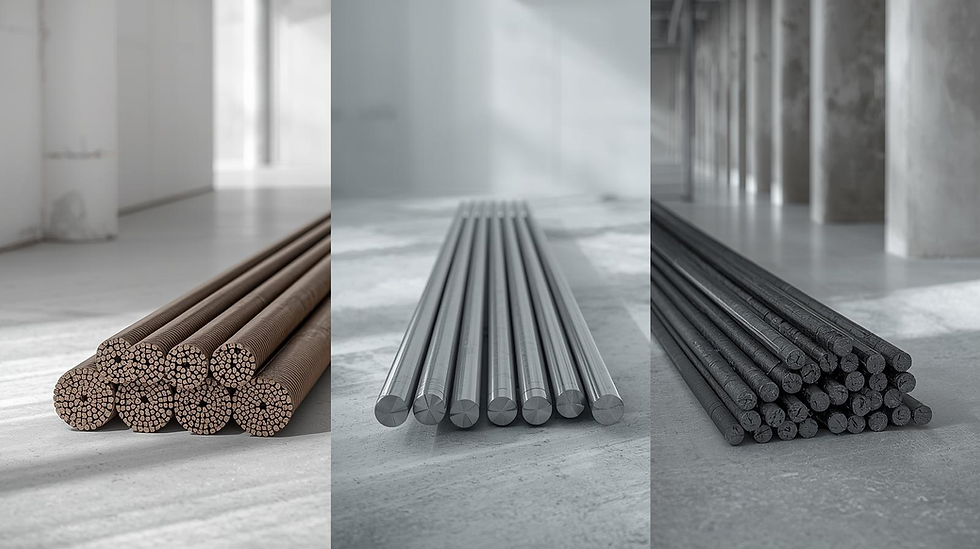
If you’ve ever been around a construction site, then you already know how important reinforcement bars or rebars are to any concrete structure. They’re the foundation that give strength and flexibility to bridges, buildings, roads, and anything made of concrete.
Traditionally, steel rebars have done a solid job in protecting infrastructures. Whether it’s carbon steel or stainless steel, they’ve been the go-to choice for decades. But as time is changing, so are materials. GFRP rebars have turned out to be a recent favourite. They are a lightweight, corrosion-free alternative that’s making engineers and contractors rethink the future of reinforcement.
Now, the big question is, how does GFRP compare with the good old steel options? Is it really better, or just a trend? Let’s know how you can decide what works best for your next project.
How Is A GFRP Rebar Made?
GFRP rebar or Glass Fiber Reinforced Polymer rebar is a new-generation reinforcement material made from continuous glass fibers that are embedded in a polymer resin, usually epoxy or vinyl ester. This combination creates a composite material that’s strong, lightweight, and non-corrosive.
These rebars are not like steel that easily rust or corrode over time, GFRP doesn’t react to moisture, salt, or chemicals. That’s why it’s becoming a preferred choice for coastal areas, marine constructions, and chemical plants where steel struggles to survive.
Some Common Traditional Rebars
Before we get into comparisons, let’s recap the two main types of steel rebars you’ve likely worked with or heard about:
1. Carbon Steel Rebar
This is the most common and affordable type. It offers good tensile strength and flexibility but is highly prone to corrosion when exposed to moisture or chemicals. Over time, rust can cause cracks and spalling in concrete and becomes a major durability issue.
2. Stainless Steel Rebar
A step up from carbon steel, stainless steel rebars resist corrosion much better, This is due to the presence of chromium content in them. They last longer in harsh environments but come at a significantly higher cost, which limits their use in everyday projects.
GFRP vs. Stainless Steel vs. Carbon Steel—How Are They Different?
1. Strength and Weight
You might be surprised to know that GFRP rebar can match, and in some cases, even exceed the tensile strength of steel. But its biggest advantage lies in its weight. GFRP rebars are nearly four times lighter than steel, making them easier to handle, transport, and install.
Carbon Steel: Offers good strength but is heavy and labor-intensive to handle.
Stainless Steel: Stronger than carbon steel and corrosion-resistant, yet still heavy.
GFRP Rebar: High tensile strength, ultra-lightweight, and easy to work with.
The reduced weight not only simplifies construction but also lowers overall project costs related to logistics and labor.
2. Corrosion Resistance
This is where GFRP rebar clearly outperforms traditional steel options. These rebars do not have the tendency to rust, corrode, or react with chemicals, even in the most aggressive environments. Whether your project is near the coast, in a humid region, or exposed to industrial chemicals, GFRP ensures a longer-lasting structure with minimal maintenance.
Carbon Steel: Highly prone to rust, leading to cracking and spalling in concrete.
Stainless Steel: Offers better corrosion resistance but can still suffer chloride-induced corrosion over time.
GFRP Rebar: 100% corrosion-proof and is ideal for coastal, marine, or chemical-exposed environments.
3. Conductivity and Magnetism
Steel rebars conduct electricity and are magnetic, which can interfere with certain sensitive applications. GFRP rebar, on the other hand, is non-conductive and non-magnetic, making it the preferred choice for structures that require electrical insulation or zero magnetic interference.
This property makes GFRP particularly suitable for facilities like hospitals, power plants, laboratories, and MRI rooms, where electrical neutrality and safety are essential.
4. Durability and Service Life
When it comes to long-term durability, GFRP rebar leads the way. Since it doesn’t corrode or degrade chemically, it maintains its strength and structural integrity for decades. This results in fewer repairs, reduced downtime, and an extended lifespan for your infrastructure.
Carbon Steel: Degrades quickly under exposure to moisture and salts.
Stainless Steel: Longer-lasting than carbon steel but still vulnerable over a long time period.
GFRP Rebar: Keeps up to its performance quality for around 75–100 years with no corrosion-related degradation or structural inefficiency.
5. Cost and Long-Term Value
At the first glance, GFRP rebars may seem more expensive than carbon steel. However, when you account for its durability, low maintenance, and corrosion resistance, it becomes far more cost-effective over the structure’s lifetime.
Carbon Steel: Low upfront cost but high long-term maintenance and repair expenses.
Stainless Steel: High initial cost with moderate maintenance requirements.
GFRP Rebar: Moderate initial investment, nearly zero maintenance, and outstanding lifespan.
You may also read : Different Types of GFRP Rebars and Their Applications
Final Thoughts
Steel will always have its place in construction, but technology has given us better options. GFRP rebar isn’t just a substitute. It’s an upgrade for structures that demand long-lasting performance without the risk of corrosion.
So, next time you plan a bridge, marine structure, or heavy-duty concrete project, think beyond traditional steel. Choosing this modern rebar will help in building smarter, safer, and more durable structures that stand strong for generations.


Comments